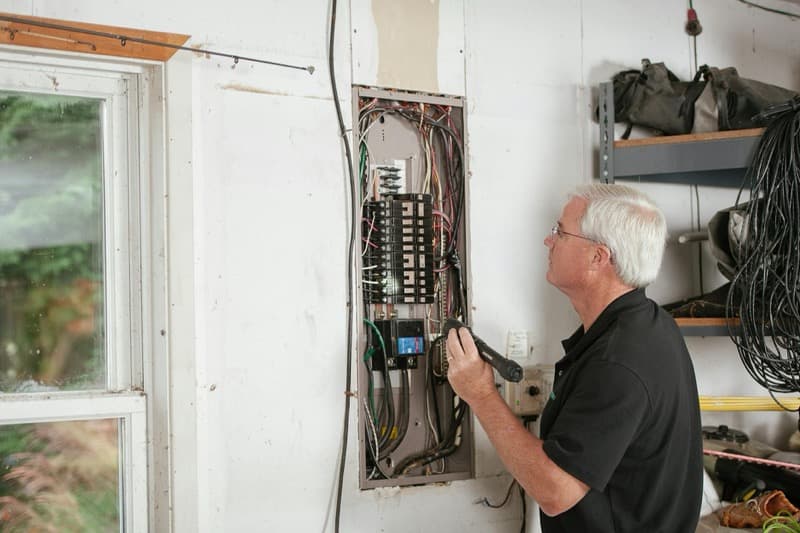
Two types of protective devices are responsible for dramatically reducing electrical-related deaths and fires in American homes: GFCI (Ground Fault Circuit Interrupter) outlets and AFCI (Arc Fault Circuit Interrupter) breakers. GFCI protection has been required in bathrooms and kitchens since the 1970s and has expanded with each NEC update — the 2023 National Electrical Code now requires GFCI protection in more than a dozen location types. AFCI protection, which protects against the arcing faults that cause an estimated 51,000 house fires per year, has been required in bedrooms since 1999 and now extends to virtually all 15 and 20-amp branch circuits in living spaces under NEC 2023. If your home was built or last rewired more than 10 years ago, it almost certainly does not comply with current GFCI and AFCI requirements — and non-compliance is not just a code violation, it is a genuine safety gap. This guide explains what each device does, where it is required, what compliance costs, and what you can DIY versus what requires a licensed electrician.
GFCI vs AFCI: What Is the Difference?
GFCI (Ground Fault Circuit Interrupter): A GFCI device detects current leaking to ground — the kind of leak that happens when electricity takes an unintended path through a person touching a faulty appliance near water. It measures the difference between current flowing out on the hot wire and current returning on the neutral wire; if that difference exceeds 5 milliamps, it trips in 1/40th of a second — fast enough to prevent cardiac fibrillation. GFCI protection is provided by a GFCI outlet (with test/reset buttons visible), a GFCI breaker in the panel, or a GFCI outlet at the first outlet in a circuit that protects downstream outlets. Cost: $15–$25 per outlet for GFCI receptacles; $35–$65 per GFCI breaker. AFCI (Arc Fault Circuit Interrupter): An AFCI device detects the signature of electrical arcing — the high-frequency sparking that occurs when wire insulation is damaged, when connections are loose, or when a nail punctures a wire inside a wall. Arcing generates tremendous heat and can ignite insulation, wood framing, and other combustibles. AFCI protection is provided by an AFCI breaker at the panel (the most common method) or a combination AFCI/GFCI outlet. An AFCI breaker costs $45–$75 versus $8–$15 for a standard breaker — the cost difference is the reason AFCI has seen resistance from homebuilders, but the life safety benefit is not in dispute.
Where GFCI Protection Is Required (NEC 2023)
- Bathrooms: all 15 and 20-amp outlets (required since 1975, now including all bathroom locations)
- Kitchens: all countertop outlets and outlets within 6 feet of a sink
- Garages and accessory buildings: all 15 and 20-amp outlets, including dedicated appliance circuits
- Outdoors: all outdoor receptacles, including 240V outlets for EV chargers in many jurisdictions
- Unfinished basements: all 15 and 20-amp outlets (not including circuits for sump pumps with no other outlets)
- Crawlspaces: all outlets
- Boat docks and boathouses: all outlets
- Laundry areas: all outlets within 6 feet of a sink
- Kitchen dishwasher circuit: required in NEC 2023
- Bathtub and shower areas: within 6 feet of the tub/shower edge
- Swimming pool, hot tub, and spa areas: all outlets within 20 feet
- Locker rooms with showers: all outlets
Where AFCI Protection Is Required (NEC 2023)
AFCI requirements have expanded dramatically over the past four NEC cycles. Under NEC 2023, AFCI protection is required for all 15-amp and 20-amp branch circuits serving dwelling unit areas including: kitchens, family rooms, dining rooms, living rooms, parlors, libraries, dens, bedrooms, sunrooms, recreation rooms, closets, hallways, laundry areas, and similar rooms or areas. Essentially, every habitable and storage space in the home now requires AFCI protection under the 2023 NEC. The main exceptions are bathrooms (which have GFCI but not AFCI under current code, though some jurisdictions require both), garages (GFCI required, AFCI not required), unfinished basements (GFCI required), and outdoor circuits. The practical implication: if you are adding new circuits anywhere in the habitable areas of your home, AFCI breakers are required. If your panel has standard breakers on circuits feeding living areas, you are not compliant with current NEC — though grandfathering generally applies to older circuits that were code-compliant when installed.
Combination AFCI/GFCI: One Device That Does Both
In many circuit locations, both AFCI and GFCI protection is required. For example, a kitchen circuit requires both AFCI (as a habitable space) and GFCI (within 6 feet of a sink). Two options exist: a combination AFCI/GFCI circuit breaker at the panel ($75–$100), which protects the entire circuit for both arc faults and ground faults, or standard AFCI breaker at the panel plus GFCI outlets at the first outlet location on the circuit (which provides downstream GFCI protection while the panel AFCI handles arc fault protection). The combination breaker approach is cleaner and does not require GFCI outlets in the circuit, but it is more expensive per circuit. For new construction or full rewires, most electricians use combination AFCI/GFCI breakers throughout. For retrofits on existing homes, installing GFCI outlets at required locations with the existing breakers replaced by AFCI breakers is usually more cost-effective.
What It Costs to Bring Your Home Into Compliance
The cost of upgrading your home's GFCI and AFCI protection depends heavily on the age of your home and how many circuits need to be addressed. For GFCI only: replacing 10–15 outlets in a typical home (bathrooms, kitchen, garage, exterior) with GFCI receptacles costs $300–$600 in materials and $400–$700 in labor for a total of $700–$1,300 installed. This is a common scope of work for pre-1990 homes. For AFCI upgrades to the panel: replacing existing breakers with AFCI breakers for bedroom and living area circuits costs $45–$75 per breaker in materials, plus $30–$60 per breaker in labor. A home with 15 circuits requiring AFCI protection would cost $1,125–$2,025 in materials and $450–$900 in labor, totaling approximately $1,575–$2,925. Many homeowners address GFCI and AFCI together when they are already doing panel work, since the panel is already open. Whole-home GFCI plus AFCI compliance for a pre-2000 home typically runs $2,500–$5,000 depending on home size and the number of circuits.
Code Compliance Note: Your home does not need to be immediately upgraded to current code unless you are doing renovation work that triggers inspections or you are selling to a buyer who makes it a condition. However, the technology exists precisely because the hazards it prevents are real. GFCI protects against electrocution near water; AFCI protects against the arc faults that cause tens of thousands of house fires per year. The investment is not bureaucratic compliance — it is genuine fire and electrocution prevention.
DIY GFCI Installation: What You Can Do Yourself
Replacing a standard outlet with a GFCI outlet is a legitimate DIY project for a homeowner comfortable with basic electrical work. The process: turn off the circuit breaker, verify the circuit is de-energized with a non-contact voltage tester (never skip this step), unscrew the existing outlet, identify the LINE terminals (the wires coming from the panel) and LOAD terminals (wires going to downstream outlets if any), connect wires to appropriate LINE terminals on the GFCI receptacle, restore power and test using the test/reset buttons. A GFCI outlet replacement typically takes 15–20 minutes per outlet for someone following instructions carefully. However, AFCI breaker replacement is generally not a DIY project. Working inside the panel involves exposure to live bus bars even with the main breaker off (the service entrance wires remain energized). AFCI breakers also require correct identification of the neutral wire pigtail connection — an error can cause the breaker to nuisance-trip repeatedly. Most electricians strongly recommend licensed professional installation for AFCI panel work.